Our Methodologies

TRIZ: The Theory of Inventive Problem Solving

Genrich Saulovich Altshuller (1926 - 1998), wondered, “Could inventions be the result of systematic inventive thinking?” Over half a century, Altshuller and his associates investigated some 200,000 patents. Their work resulted in the breakthrough discovery that of ninety-five percent of all patents used only seven inventive tools. Only five percent come from breakthroughs in science and brand new ideas. They found that exceptional patents improved performance by resolving contradictory requirements, like increasing speed without higher fuel consumption. Another revelation was the frequent occurrence of a windfall of benefits, or super effects, which arose from resolving a system’s fundamental contradiction. Not only were many costly add-ons and expensive tolerances were no longer required, many systems had inherited valuable, new, product differentiating, capabilities and features. Altshuller also found that if patents were categorized by what they did functionally, rather than by industry, the same problem had been solved over and over again with just a handful of inventive techniques. The result, TRIZ, a Russian acronym for The Theory of Inventive Problem Solving, provides us with a methodology for engineered creativity.

TRIZ is a methodology that provides product and process designers with inventive problem solving tools that not only accelerate the design process but help them achieve world class performance improvements beyond the trade-offs most designers consider unavoidable. Because TRIZ uses a functional approach to problem solving, it is equally applicable to solving business dilemmas faced by a giant steel mill as it is for micro-chips or potato chips. It reaches across many different functional lines, not just product development.

Over many years, Altshuller investigated over 200,000 patents (to date over 1,500,000 patents have been investigated), to see how they were solved. He found that exceptional patents resolved contradictory requirements, like increasing speed without higher fuel consumption, that is without trade-offs. Furthermore, by categorizing patents on what they did functionally, rather than by industry, he found that the same problem had been solved over and over again across many industries.

TRIZ can provide the marketing team with inventive techniques for product renaissance, both through product differention and competitive analyses. They can ‘Jazz-up’ their products with brand new applications, or they can put ‘wings’ on their product or process with desirable new features.

Finally, TRIZ is an inventive problem solving tool that can be used by the continuous improvement team in charge of Value Analysis/Value Engineering (VA/VE), ‘Lean’ or ‘Six sigma’ initiatives. In a most uncompromising way, TRIZ can be used to ‘cut off’, i.e. eliminate costly and poor quality components and then make the pruned system work again through applying several inventive techniques. Saying it another way, TRIZ defines the problem and then walks around it with inventive techniques to find a solution

In conclusion, a few words about creativity activation are in order. In facing a problem solution space, most of our knowledge is confined to our industry, background, and education. We can start fresh each time by using Trial & Error, Brainstorming, or other creativity unleashing methods like Synectics, to generate ‘Out of the Box’ solutions. But there are other choices. Should we try to get as many ideas as possible (brainstorming), or should we try to get quality ideas? What’s more important: head count, i.e. many ‘brainstormers’ in one room, or head content? Should we emulate the traits of great inventors or should we use their tools?

Our choice is to get the best ideas from the best inventors by using their best tools, TRIZ, a methodology, derived from empirical data (not theory) of the world-wide patent base.

TRIZ provides a systematic approach for idea generation and process improvement. It speeds up creative thinking, and significantly expands the range of problem solving options.

to top

LEAN MANUFACTURING AND TRAINING

Lean: Our approach to lean manufacturing and product design employs the principles of the Toyota Production System, TPS, developed by Taiichi Ohno, president of Toyota (Gosei).

Benefits of Lean:
  • Throughput: + 40 --> 80%
  • Manufacturing Lead Time: - 50 --> 90%
  • Work-in-Process: - 60 --> 80%
  • First-Pass Yield: + 50 --> 100%
  • Floor Space: - 5 --> 50%
  • Capitalization cost: - 50%
  • On-time Delivery: +99%
  • Administrative Cycle Time: - 50 - 90%

Tools and Training:
  • Employee Involvement: We use a people-centric, learn by doing, and training, team based approach that evolves into self-directed teams
  • Enterprise-wide Value Stream Mapping: Time-based value add, VA/VE analyses
  • TOC, Theory of Constraint Analyses: To find the organization’s fundamental constraint or conflict and solve it in a ‘Win- Win’ way
  • Balanced ‘Smoothed Flow: Controlling the input, minimize over/under production
  • Kanban Design: What, when, how much to produce
  • Work Cells Design, Single Piece Flow, Factory Layout: Keep things moving
  • SMED: Single minute die exchange; Maximize throughput, minimize work-in- process, mixed model builds, short lead time deliveries
  • Scheduling: HMLV, High Mix Low Volume production
  • Six Sigma: Problem solving and process/product design
  • TPM: Total Production Maintenance
  • Five-S

Course Formats:
  • On-site, customer training or
  • Web-cast TRIZ training
    1. - 2.1: Intensive, one day (8 hour) six sigma quality training
    2. - 2.2: Extended, eight, one hour sessions

Handouts:
  1. Course: notes, problems and solutions
  2. Problem solving templates

to top

SIX SIGMA QUALITY AND TRAINING

Overview: PRIMA Performance Ltd. specializes in implementing six sigma quality initiatives to dramatically improve corporate profits. Our methodology is based on the original six sigma initiatives derived by Bill Smith at Motorola from luminaries like Shewhart, Deming, and Shainin.

Course Outcomes: Attendees will:
  • We use the ‘KISS’, Keeping It Statistically Simple technique so that direct labor can use these techniques
  • Understand how to find the root cause of a problem
  • Understand how to eliminate the root cause and provide six sigma products and processess
  • Understand how to design robust products and processes
  • Obtain confidence in the application of six sigma quality improvement techniques

Course Outline:
  • Brief Overview: Not every problem needs to be solved. TRIZ gives us INVENTIVE techniques to walk around many problems and thus may eliminate the need for the following tools.
  • Process Mapping/Problem Elimination Roadmap: A generic, step-by-step template for separating the critical few from the trivial many
  • Measurement system adequacy: Product versus measurement system discrimination
  • Pareto Principle: 80% of problems due to 20% of the causes
  • R. Kipling’s 5 W’s: What, who, when, where, why
  • Component Search: For finding the problem components in mechanical systems
  • Multi-vari Chart: To determine spatial versus temporal versus whole/part problem dependency
  • Paired Comparison: To flush out the root cause by comparing the good versus bad parts
  • B vs C: A quick check to establish confidence that our new, ‘Better’ process, is in fact an improvement over our ‘Current’ process
  • Variables search: The Rolls Royce of DOE’s
  • Factorial Analysis: Separation and quantification of varibles/interaction
  • Scatter Plots: For realistic tolerances
  • SPC and Pre-control Charts: To lock up critical variables in a maximum security prison

Course Formats:
  • On-site, customer training or
  • Web-cast TRIZ training
    1. - 2.1: Intensive, one day (8 hour) six sigma quality training
    2. - 2.2: Extended, eight, one hour sessions

Handouts:
  1. Course: notes, problems and solutions
  2. Problem solving templates

to top

Theory of Constraints

Scenario:

A company was loosing customers. Rather than embark on one of the flavor-of-the- month productivity initiatives, and mobilize the whole company, they decided to use a more surgical approach, The Theory of Constraints. Per this approach they asked their employees, “What UnDesirable Effects, UDE’s, are causing us to loose money?”

UDE Input:

  1. Our employees are incompetent,
  2. Our products are very difficult to build,
  3. We have too much fallout,
  4. It’s impossible to meet customer delivery dates,
  5. We need more workers,
  6. Our manufacturing lead times are too long, and
  7. Our prices are too high.

Next, we link the above UDE’s (dashed boxes) with other legitimizing, real world, requirements (solid boxes), in a cause-effect-cause…… chain back to the root cause, “We hire temporary workers”. This diagram, called a Current Reality Tree, CRT, is shown below.


NOTE: We read the CRT from the bottom: IF (box @ tail of arrow) Then (box @ tip of arrow). Multiple arrows going into one box are OR’d, e.g. IF (A) OR IF (B) OR IF (C) Then (D)……

Arrows that have a “doughnut” around them are AND’d, e.g. IF (A) AND IF (B) AND IF (C) Then (D)...

Current Reality Tree

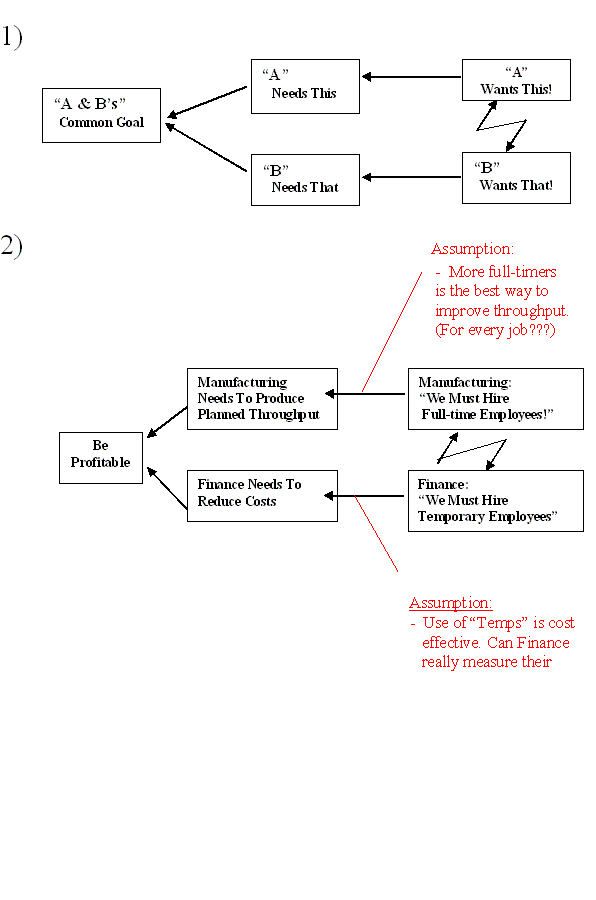
One of the most important benefits of the CRT is its ability not only to define the root cause of our problem but more importantly, to unearth the conflict that has prevented us from solving this problem in the first place. From this CRT we can see that the company is caught in a self-feeding downward spiral of two conflicting requirements, the need for more workers on one hand and cost containment on the other (i.e. not able hire expensive, “more competent” full time employees).

Next, we start to show how we might solve this conflict, or CLOUD.
As mentioned in the above CRT description, we see that the root cause of our problem is our temporary employee hiring policy. What is particularly frightening is that we are in a “death spiral” or loop that will make things go from bad to worse. We are caught in a conflict, or “CLOUD”, where on the one hand we need more employees to build product, and on the other hand, because of cost pressures, we can only hire “low cost”, and inefficient temporary workers.

Below we show how to build:

  1. A generic cloud, and
  2. The cloud for our problem. A couple of possible solutions (in red) to our dilemma are also shown between Wants, and Needs.
to top

Copyright, 2003 by Gunter Ladewig. All rights reserved